
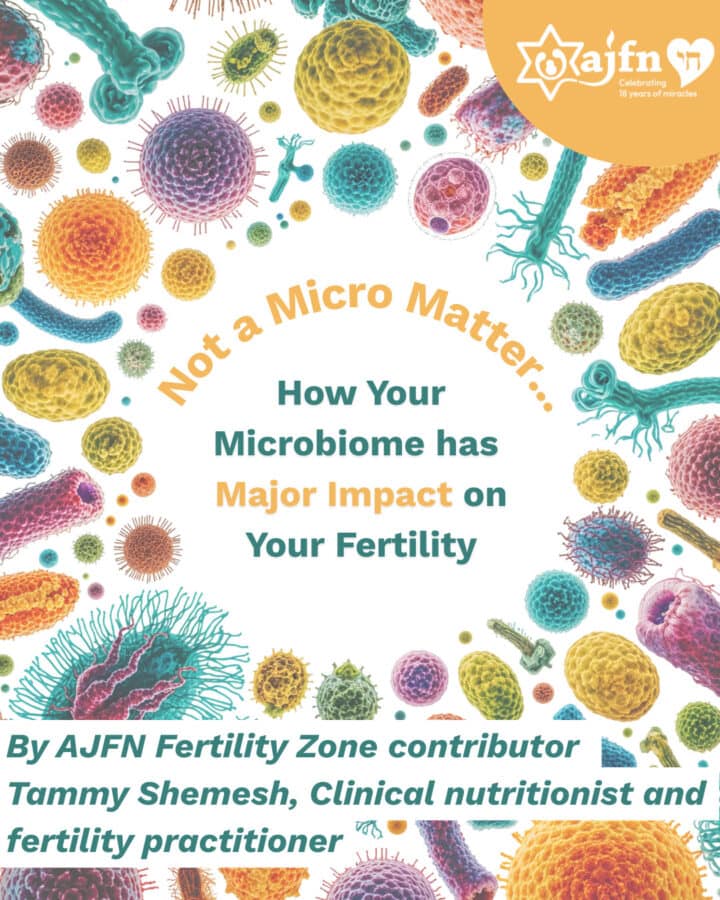

By Tammy Shemesh – clinical nutritionist and certified fertility practitioner
If you’ve been trying to conceive for a while, you’ve probably heard all the usual advice: track your ovulation, take your prenatals, cut down on alcohol and reduce stress. All of those things matter, but there is a quieter, often overlooked part of your body that may have far more influence than we once believed. That hidden factor is your microbiome.
Your microbiome is the collection of bacteria and other microorganisms living inside and on your body – in your gut, your vagina, and even in your uterus. They’re tiny, but they have a surprisingly big impact on how your hormones behave, how your immune system responds, and whether your body feels “safe” enough to support a pregnancy. And the best part? Unlike your genetics or your age, your microbiome is something you can influence.
The Microbiome: Your Body’s Internal Garden
Think of your microbiome like a garden. The right plants grow easily, the soil is rich, and everything thrives with little effort. But if weeds take over or the soil becomes too dry, even the strongest seeds struggle. The same goes for fertility. A healthy microbiome helps your hormones communicate clearly, keeps inflammation down, and creates a receptive environment for implantation. An imbalanced microbiome (called dysbiosis) can quietly interfere with conception even when everything else seems “normal” on paper. Let’s break down the three most important microbiomes for fertility.
Your Gut Microbiome
Most people don’t realise this, but your gut is a major fertility organ. It influences your reproductive health through three main jobs:
1. It manages your oestrogen – Certain gut bacteria help break down and recycle oestrogen. When they’re out of balance, oestrogen can build up or be recycled in the “wrong” form, contributing to issues like PMS, PCOS, fibroids, and endometriosis.
2. It reduces inflammation – A healthy gut produces short-chain fatty acids (SCFAs) that lower inflammation throughout the body, including the reproductive system.
3. It supports your stress response – Your gut helps regulate neurotransmitters (like serotonin), which influence your mood, sleep, and cortisol levels. Stress and high cortisol can interfere with ovulation and implantation. If your gut microbiome is off, your whole reproductive system feels it.
Your Vaginal Microbiome
Your vagina has its own ecosystem, and during your fertile window, it becomes the environment sperm must travel through to reach the egg. The ideal vaginal microbiome is dominated by friendly bacteria called Lactobacillus.
These bacteria produce lactic acid, which keeps the vaginal pH slightly acidic. This acidic environment can:
● Protect against infections
● Keep inflammation low
● Support sperm survival
● Helps sperm move toward the cervix
● Creates a healthy environment for implantation If harmful bacteria take over (often after antibiotics, stress, or hormonal changes), the environment becomes more alkaline and inflamed. This can make it harder for sperm to survive and may even reduce IVF success rates.
Your Uterine Microbiome
Until a few years ago, doctors believed the uterus was sterile. Research now shows that it has its own microbiome and it plays a major role in whether an embryo implants and thrives.
A uterus dominated by Lactobacillus is associated with:
● Higher implantation rates
● Better IVF outcomes
● Lower inflammation
● Healthier early pregnancy environment
When the uterine microbiome is imbalanced, it’s like planting a seed in depleted soil even the best embryo struggles to grow.
Your Partner’s Microbiome Also Matters
Fertility is a team sport, and your partner’s microbes play a big role too. The bacteria in semen (the seminal microbiome) can influence:
● Sperm motility
● DNA integrity Oxidative stress
● How your immune system responds after intercourse
You and your partner even share microbes through intimacy. So when one partner works on their microbiome, it often benefits both.
The Microbiome & Fertility: Signs You Should Pay Attention
You might want to explore your microbiome if you experience:
● Recurrent thrush or bacterial vaginosis, IBS or digestive issues
● PMS, irregular cycles, heavy or painful periods
● Endometriosis or PCOS
● Repeated implantation failure
● “Normal” hormone tests but ongoing fertility issues
● Reduced IVF success despite good embryos
● Chronic gum inflammation (yes, oral health is linked too!) These symptoms often point to deeper imbalances within your microbial ecosystems.
How to Support a Fertility-Friendly Microbiome
You don’t need an extreme overhaul, small, consistent steps are powerful.
For your gut
● Eat 30+ different plant foods each week
● Include fermented foods (natural yogurt, kefir, kimchi, sauerkraut)
● Reduce processed foods and excess sugar
● Focus on fibre (veg, whole grains, legumes)
● Manage stress and prioritise sleep For your vaginal and uterine health
● Avoid scented washes or douching
● Wear breathable underwear and avoid tight synthetic fabrics
● Consider targeted probiotics
● Ask your practitioner about vaginal or endometrial microbiome testing
For your partner
● Increase antioxidants (berries, leafy greens, olive oil, nuts)
● Reduce alcohol
● Improve gut health (their microbiome affects sperm!)
● Prioritise sleep, movement, and stress management
For your mouth
● Treat gum inflammation early
● Brush and floss daily
● See a dentist if trying to conceive
All these small habits help nourish the ecosystems that support conception.
So… Could Your Microbiome Be the Missing Piece?
If you’ve been trying to conceive and feel like you’re doing everything right but something still isn’t clicking, your microbiome may be playing a bigger role than you realise. The empowering part is that microbiomes are changeable. With the right support, testing, and lifestyle shifts, many women finally see the progress they’ve been waiting for.
Want to Understand Your Fertility Microbiome?
In my practice, I help women identify which microbial imbalances might be impacting their fertility and build personalised plans to restore balance naturally.
Book your complimentary consultation here. https://www.tammyshemesh.com/
About Tammy Shemesh
Tammy Shemesh is a clinical nutritionist and certified fertility practitioner who combines evidence-based science with compassionate care to help couples navigate their fertility journeys. With extensive training in reproductive health and microbiome therapeutics, Tammy specializes in identifying and addressing the nutritional and microbial factors that influence conception, pregnancy, and overall reproductive wellness. Drawing from the latest research in fertility science, Tammy has helped numerous individuals and couples optimize their internal ecosystems through targeted nutrition, lifestyle modifications, and microbiome support. Her holistic approach recognizes that fertility is not just about timing and hormones, but about creating the optimal conditions for life to flourish. Tammy is passionate about empowering her clients with knowledge and practical tools, helping them understand their bodies as complex, intelligent systems capable of healing and transformation. She believes that every fertility journey is unique and deserves personalised, compassionate support that addresses the whole person, not just the symptoms.
References
1. Baker JM, Al-Nakkash L, Herbst-Kralovetz MM. Estrogen-gut microbiome axis: Physiological and clinical implications. Maturitas. 2017;103:45-53.
2. Moreno I, Codoñer FM, Vilella F, et al. Evidence that the endometrial microbiota has an effect on implantation success or failure. Am J Obstet Gynecol. 2016;215(6):684-703.
3. Ravel J, Gajer P, Abdo Z, et al. Vaginal microbiome of reproductive-age women. Proc Natl Acad Sci U S A. 2011;108 Suppl 1(Suppl 1):4680-7.
4. Weng SL, Chiu CM, Lin FM, et al. Bacterial communities in semen from men of infertile couples: metagenomic sequencing reveals relationships of seminal microbiota to semen quality. PLoS One. 2014;9(10):e110152.
5. Fardini Y, Chung P, Dumm R, et al. Transmission of diverse oral bacteria to murine placenta: evidence for the oral microbiome as a potential source of intrauterine infection. Infect Immun. 2010;78(4):1789-96.
6. Koedooder R, Singer M, Schoenmakers S, et al. The vaginal microbiome as a predictor for outcome of in vitro fertilization with or without intracytoplasmic sperm injection: a prospective study. Hum Reprod. 2019;34(6):1042-1054.
7. Crusell MKW, Hansen TH, Nielsen T, et al. Gestational diabetes is associated with change in the gut microbiota composition in third trimester of pregnancy and postpartum. Microbiome. 2018;6(1):89.
8. Llahi T, Papageorgiou M, Chambers GM, et al. The microbiome and assisted reproductive technology. Semin Reprod Med. 2023;41(1-2):24-34.
9. García-Velasco JA, Menabrito M, Catalán IB. What fertility specialists should know about the vaginal microbiome: a review. Reprod Biomed Online. 2017;35(1):103-112.
10. Altmäe S, Franasiak JM, Mändar R. The seminal microbiome in health and disease. Nat Rev Urol. 2019;16(12):703-721.